
Geography
At Bewley Primary School, our geography curriculum helps pupils become curious and knowledgeable about the world around them. We want them to understand people, places and environments and how they are connected. We want them to take pride in Billingham and its place in the wider world.
Our school sits in Billingham in Stockton-on-Tees. It is a town with a strong industrial history and a diverse community. Pupils learn how Billingham fits into Teesside, the North East, the United Kingdom and the world.
Our curriculum is built on the four strands of the national curriculum:
- Geographical skills and fieldwork: using maps, atlases, digital tools and fieldwork to ask and answer questions
- Locational knowledge: knowing where places are locally, nationally and globally
- Place knowledge: understanding how places are similar and different
- Human and physical geography: understanding how people and natural processes shape the world
We want pupils to:
- Understand sustainability and their role as global citizens
- Know key facts and remember them over time
- Use precise geographical vocabulary when they speak and write
- Build map skills step by step from simple directions to latitude and longitude
- Carry out real fieldwork in their local area
This reflects our “Bright, Proud, Successful” school motto. We see geography as a window to the world that sparks curiosity and respect for our planet.


Implement
Geography is taught every half term from Nursery to Year 6. Our scheme of learning is bespoke to Bewley. It was written around our school, Billingham and the wider Teesside area so pupils see why geography matters to them.
Three documents shape every lesson:
- Schemes of Learning: the learning objective, success criteria, strand and task for every lesson
- Progression of Knowledge and Skills: what pupils should know and be able to do in each year for each strand
- Vocabulary Progression: the key words for each year. Pupils meet earlier words again in new places.
Lesson structure
Every geography lesson follows the same structure so pupils know what to expect:
- Remember: retrieval questions from earlier lessons and years
- Today’s Geographical Skill: the skill is shared with its strand icon
- Success criteria: pupils know exactly what they need to show
- Teaching: real photos, aerial images, maps and Google Earth. “Closer to home” links compare new places with Billingham.
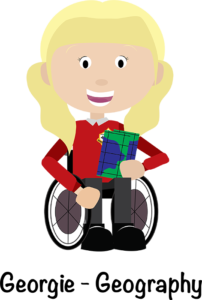
- Georgie’s question: Georgie Geography poses a question or a true or false statement. Pupils discuss it using “Do you agree? Can you build on that? Can you challenge that idea?”
- I do, We do, You do: the teacher models, the class practises together and pupils then work independently
- Explore further: a QR code and challenge to deepen thinking
Tasks
Each task comes from the scheme of learning and takes one of three forms:
- A worksheet that shows every success criterion
- A written task alongside a practical activity
- A practical outdoor activity recorded through photographs
Photographs from practical lessons are uploaded to Seesaw. This means every practical lesson has clear evidence of the learning.
Billingham and Beyond
Every year group studies a local unit with fieldwork. Pupils explore the Transporter Bridge, measure the River Tees, survey land use in Billingham and investigate the Stockton and Darlington Railway. In Year 6, they plan and carry out their own local enquiry.
Map skills and technology
Map skills build each year. Pupils start with the four compass points and move on to aerial photos, OS maps, grid references, contour lines and latitude and longitude. They use atlases, Google Earth, digital maps and satellite images. Pupils use Seesaw to record and share their work through photos, maps, videos and voice notes.
Links with other subjects
Many units link with history and science. Examples include the Bronze Age, Captain Cook, Darwin’s voyage, the Second World War and the water cycle.
Inclusion
Lessons are planned for all learners. Tasks include built-in support such as word banks, picture cards, sentence starters and worked examples. This lets every pupil access the same geographical thinking.
Find out more
- Geography Curriculum Road Map: what pupils learn in each year group across the four strands
- Progression of Knowledge and Skills in Geography: how knowledge and skills progress across year groups


Curriculum Impact
Through our geography curriculum, pupils at Bewley Primary School become:
- Confident geographers who understand places locally and globally
- Knowledgeable about Billingham, Stockton-on-Tees and how these fit into wider contexts
- Critical thinkers who ask questions, analyse evidence and draw conclusions
- Respectful citizens who value people and the environment
- Effective communicators who share findings in writing, presentations, maps and diagrams
We measure impact through pupil discussions, learning walks, book reviews and checks of pupils’ work on Seesaw. We review Foundation Assessment Sheets and look for high-quality work showing that pupils remember and apply what they learn.
By the time they leave Bewley Primary School, pupils are Bright, Proud and Successful geographers who understand the world and have the skills to keep exploring as lifelong learners.


